Most people know that THC gets you high. Fewer know what that means at the level of brain chemistry and specific regions lighting up or going quiet. What does weed do to your brain, exactly?
We've been watching Canadians navigate cannabis for over two decades, from the gray market to regulated shelves. Here's the neuroscience, explained without the clinical distance.
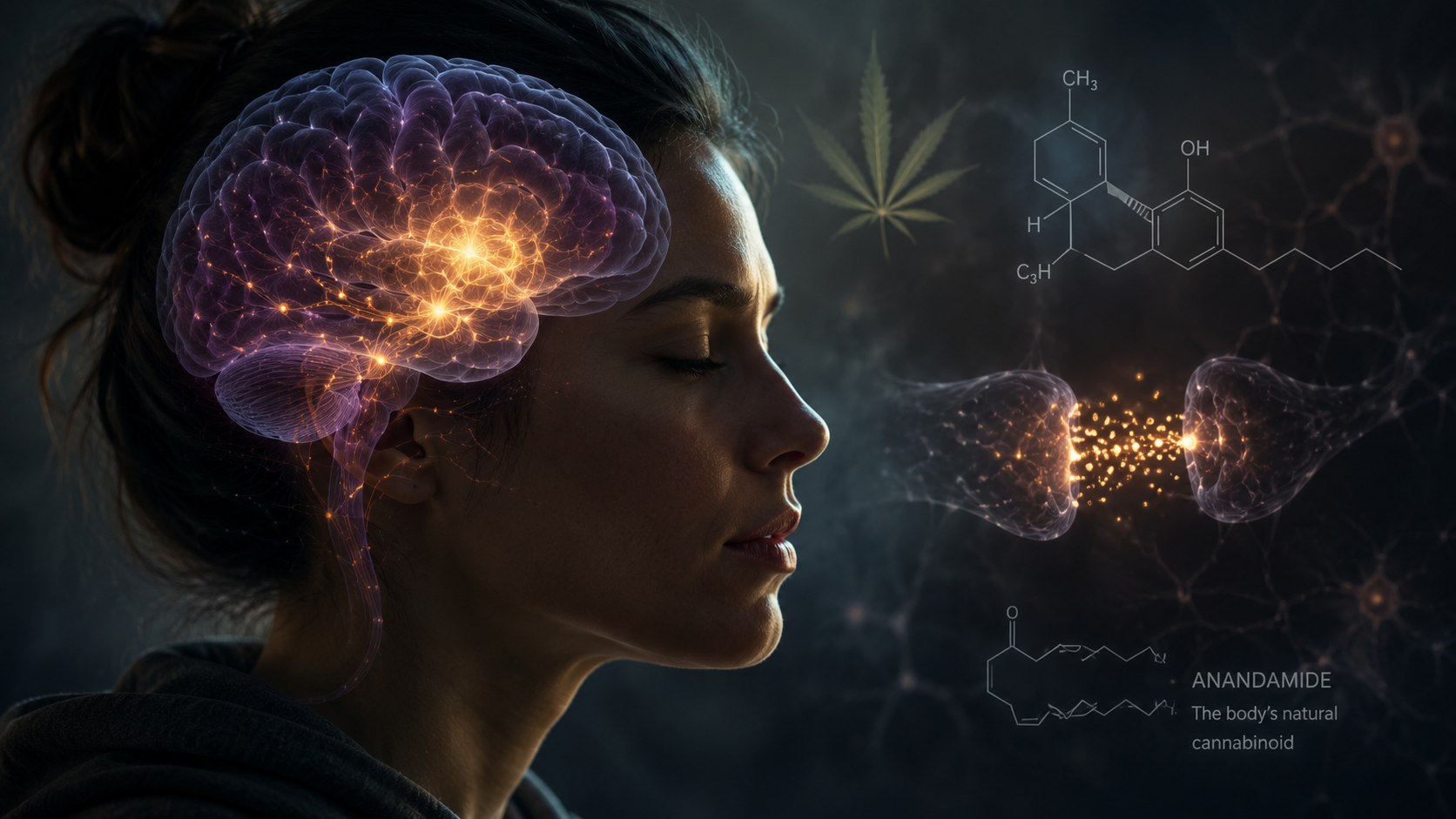
Why Does Your Brain React to THC?
Your brain has a built-in system designed to receive THC. Not by accident, but because THC mimics chemicals your brain produces naturally.
The Endocannabinoid System: Your Brain's Built-In Cannabis Receptor Network
Your brain runs on a system called the endocannabinoid system(ECS), a network of neural receptors woven through virtually every region of the brain and body.
The ECS regulates:
Mood
Memory
Sleep
Appetite
Pain
Stress response
It is core infrastructure, not a fringe system.
The ECS operates through endogenous cannabinoids: chemical messengers your body produces on demand. These molecules cross synapses and regulate neural communication by modulating neurotransmitter release.
The most well-known is anandamide, nicknamed the bliss molecule for its role in generating feelings of calm, pleasure, and wellbeing. Anandamide works by binding to CB1 receptors on neurons throughout the brain, modulating how signals fire and how strongly the brain responds to stimuli.
CB1 receptors concentrate in the regions that matter most:
the hippocampus (memory)
the prefrontal cortex (decision-making)
the amygdala (fear response)
the cerebellum (coordination and time perception)
How THC Hijacks the System: Mimicking Anandamide but Going Much Further
THC's molecular structure closely resembles anandamide. That similarity is why the body recognizes it and why it can bind to the same CB1 receptors.
But there's a critical difference in how the two chemicals behave once inside the system: Anandamide is produced in small amounts, acts locally, and breaks down within minutes. THC arrives in much larger quantities.
When you smoke or inhale cannabis, it reaches the bloodstream and brain within minutes; edibles take longer but produce the same receptor binding. Either way, THC lasts far longer than any natural cannabinoid. Instead of fine-tuning the ECS, it floods the system, activating receptors at a scale the brain isn't designed to handle naturally.
The result is a cascade of psychoactive effects across every brain region where CB1 receptors sit. The high isn't one thing in one place. It's a simultaneous shift across systems. THC doesn't knock on the door; it walks in and rearranges the furniture.
What THC Does to Your Brain: Region by Region
Once THC binds to cannabinoid receptors throughout the brain, it alters brain activity and brain function across multiple regions simultaneously. Here's what's actually happening in each key area.
1. The Hippocampus: THC and Short-Term Memory
The hippocampus is the brain's memory formation centre, one of the most CB1-dense regions, making it highly sensitive to THC.
When THC disrupts hippocampal function, the result is impaired memory, specifically the short-term, working memory kind. This is why you forget what you were saying mid-sentence when you're high, or can't hold onto a thought long enough to express it. Studies confirm that THC intoxication causes measurable difficulty accessing verbal memories. Once the THC clears, that impairment largely resolves for most people.
With chronic heavy use, the concern is cumulative: longer-lasting cognitive function changes, particularly around working memory and learning efficiency. The evidence is strongest for people who start young. For adult occasional users, the disruption is real but largely temporary.
2. The Prefrontal Cortex: Decision-Making, Self-Control, and the High-Dose Problem
The prefrontal cortex is your brain's executive centre, the region responsible for:
Decision-making
Judgment
Self-control
Planning
Keeping impulsive behaviour in check
It is also one of the last regions to fully develop, not reaching maturity until around age 25.
THC reduces both activity and connectivity within the prefrontal cortex. Research shows decreased functional connectivity, with the effect strongest in those experiencing more severe intoxication. This translates practically to impaired judgment, slower reaction time, reduced concentration, and impulsive decisions.
This effect is strongly dose-dependent. At low doses, THC's impact on the prefrontal cortex is more subtle. At high doses, especially with high-potency products, the disruption can be significant. Understanding this relationship is one of the strongest arguments for paying attention to THC concentration before consuming.
For a closer look at how sativa strains specifically affect mental stimulation and cognition, see our guide to sativa effects on the mind.
3. The Amygdala: The Anxiety Switch
The amygdala is the brain's fear and emotional processing hub. It regulates the fight-or-flight response and plays a central role in how we experience anxiety. THC's interaction here is dose-dependent in a way that directly explains why cannabis can feel calm and pleasant for one person and deeply anxious for another.
At low doses, THC inhibits glutamate in the amygdala, and the result is calming.
At high doses, glutamate accumulates, and the amygdala activates, producing anxiety, paranoia, and panic.
This is why dose matters more than most people realize, and why the amygdala amplifies whatever emotional state you bring in.
For strain-specific guidance on managing anxiety, see our piece on the best weed strains for anxiety.
4. The Cerebellum and Basal Ganglia: Coordination, Time Perception, and the Munchies
The cerebellum manages coordination, balance, and motor control (and it has a high concentration of CB1 receptors). When THC disrupts cerebellar function, you get impaired coordination, slower reaction time, and the classic altered sense of time.
MRI studies show THC alters blood flow to the cerebellum; that's why time appears to slow down. Sensations feel more intense because the brain's normal self-moderation is disrupted, and the feedback loop runs longer before resetting.
The basal ganglia regulate movement and habit formation. The nucleus accumbens and hypothalamus govern appetite and reward. THC hijacks both by mimicking anandamide, triggering a dopamine-mediated craving for food that bypasses your last meal. That's the munchies, explained at the receptor level.
Dopamine and THC: Why THC Feels Good
How THC Triggers a Dopamine Rush
Dopamine is the brain's primary reward chemical. It is released when you do something the brain wants to repeat. It's also central to the intoxicating quality of the THC experience.
Historically, it was calibrated for survival behaviours: eating, sex, and social bonding. The reward system uses anandamide to release dopamine in controlled, modest amounts as part of this regulatory process.
THC disrupts that regulation via an intensely euphoric, well-being-saturated state. THC doesn't just make you feel good; it hijacks the brain chemistry that determines what feels good at all.
Tolerance, Dependency, and the Downregulation Problem
The brain is a self-balancing system. When dopamine is flooded repeatedly through regular cannabis use, the brain adapts by reducing the number of dopamine receptors available, a process called downregulation. Fewer receptors mean the same dose of THC produces a weaker response over time. This is tolerance buildup: the need for progressively more THC to achieve the same effect.
With heavy chronic use, downregulation can reach a point where everyday activities (food, music, social connection) feel less rewarding sober. This is part of how cannabis use disorder develops, and why some heavy users report feeling flat without cannabis. It's brain chemistry, not character.
This is largely reversible. A tolerance break allows receptors to upregulate again. It underscores why frequency matters: the brain adapts to patterns.
Read more about how THC affects your sleep.
Short-Term vs. Long-Term Effects of THC in the Brain
The Short-Term Effects of THC: First Few Hours
The acute effects of THC are well-documented and, for most adult users in moderate doses, largely positive in the short term. The most commonly reported short-term experiences include:
Stress relief and anxiety reduction
Pain relief, particularly for chronic and inflammatory pain
Euphoria and a general sense of pleasure and well-being
Mood elevation and calming, relaxing effect
Altered time perception and sensory enhancement
Increased appetite
For most people who consume cannabis and perceive its effects, being intoxicated produces measurable impairments:
Impaired short-term and working memory (memory loss that resolves when THC clears)
Reduced reaction time and impaired coordination
Impaired judgment and decision-making
Anxiety, paranoia, or panic at high doses in sensitive users
Disorientation and a temporary disconnect from normal perception
For most people, these resolve as the THC metabolizes, typically within a few hours. The primary concern for acute use is safety-sensitive activities: driving, operating machinery, anything requiring full cognitive function.
The Long-Term Effects of THC: Memory, IQ, and Mental Health
The long-term effects of cannabis use on the brain are where the research gets more complicated. The weed and the brain conversation is often distorted in both directions: either minimized or exaggerated.
Does weed kill brain cells? Not in the straightforward sense, but heavy chronic use is associated with memory problems, reduced IQ (especially with adolescent onset), and increased risk of depression, anxiety, and cannabis use disorder. The link between heavy use and psychosis risk is real, particularly for people with a personal or family history of schizophrenia or bipolar disorder.
Long-Term Effects of Cannabis in Teenagers
THC effects on the teenage brain are distinct and more serious. Brain development continues until around age 25, with the prefrontal cortex and hippocampus among the last regions to fully mature. THC exposure during this developing brain period carries greater vulnerability to lasting cognitive effects (impaired memory, reduced IQ, and disrupted brain development) than adult-onset use.
The mental health risks are also elevated: researchers have found associations between adolescent heavy use and cortical thinning in regions tied to decision-making, as well as increased schizophrenia risk in those predisposed.
What This Means for How You Actually Use Cannabis
For cannabis strains for focus and productivity, the prefrontal cortex findings matter: high-THC at high doses is the wrong call if cognitive performance is the goal.
Dose and Potency: Why They Matter More Than Most People Realize
The single most important variable in the THC brain experience is dose: dosage determines whether you're calming or activating the amygdala, and how much the prefrontal cortex is affected.
THC concentration in legal cannabis varies enormously, from below 10% to above 30%. A few draws on a 28% product deliver a neurologically different experience than the same draws on a 14% product. Health Canada's start-low-go-slow guidance exists precisely because the dose-response curve is steep and varies by body weight, tolerance, and individual CB1 receptor distribution.
Lot420's select-batch approach means every product comes with a known THC concentration, so you're not guessing at dose. This is exactly the kind of transparency that makes the start-low guidance actually actionable.
For pain use cases, see our guide to cannabis for pain relief.